THE OMANIS:
PRONUNCIATION: oh-MAHN-eez
LOCATION: Oman
POPULATION: 1.5 million
LANGUAGE: Arabic; English
RELIGION: Islam (Ibadi sect)
The present-day land of Oman was home to a fairly advanced civilization as far back as about 5000 BC . From 3000 BC until AD 1500, the Omanis were a prosperous, sea-faring, export-oriented people. During the sixth to seventh centuries AD , Islam was brought to Oman by the Arabs.
During the early to mid-nineteenth century, Oman became an important commercial center for the Persian Gulf area, and relations with other countries were developed. In the 1860s, the invention of the steamship and the opening of the Suez Canal eliminated the demand for Omani sailing ships and the need to stop at Omani ports. Oman entered a time of economic hardship, which lasted until oil production began in 1970. Until 1970, Oman also had been kept completely isolated by a succession of rigidly fundamentalist rulers. In 1970, Sultan Said bin Tamir was forced into exile by his son,
Qaboos, who then became sultan. Sultan Qaboos began the production of oil and used the profits to make much-needed improvements in the country. Sultan Qaboos has brought electricity and running water, free modern education and health care, and great improvements in housing and roadways to Omanis.
The population of Oman is over two million. Approximately three-quarters are Omanis. The capital is Muscat, located on the northeast coast. All Omanis are Arabs.
reaches a drenching 96 percent.
“Hello” in Arabic is marhaba or ahlan, to which one replies, marhabtayn or ahlayn. Other common greetings are As-salam alaykum (Peace be with you), with the reply of Wa alaykum as-salam (and to you peace). Ma’assalama means “Goodbye.” “Thank you” is Shukran, and “You’re welcome” is Afwan. “Yes” is na’am and “no” is la’a. The numbers one to ten in Arabic are wahad, ithnayn, thalatha, arba’a, khamsa, sitta, saba’a, thamanya, tisa’a, and ashara.
Arabs’ names consist of their first name, their father’s name, and their paternal grandfather’s name. Women do not take their husband’s name when they marry. They keep their father’s family name as a sign of respect for their family of origin. First names usually indicate an Arab’s religious affiliation. Muslims use names with Islamic religious significance, such as Muhammad and Fatima, while Christians often use Western names, as well as Arabic Christian names, such as Elias and Butrus.
The Islamic religion has five so-called “pillars”: (1) Muslims must pray five times a day; (2) Muslims must give alms, or zakat, to the poor; (3) Muslims must fast from dawn to dusk during the holy month of Ramadan; (4) Muslims must make the pilgrimage, or hajj, to Mecca (the spiritual center of Islam, located in Saudi Arabia); and (5) each Muslim must recite the shahada, which in English means, “I witness that there is no god but Allah and that Muhammad is the prophet of Allah.” Arabs say all their prayers facing in the direction of Mecca.
Islam is a simple, straightforward faith with clear rules for correct living. It is a total way of life, inseparable from the rest of one’s daily concerns. Therefore, there is no such thing as the “separation of church and state” in Islamic countries such as Oman.
Births are an occasion for celebration, particularly if the child is a boy. Weddings are perhaps the most elaborately celebrated occasions, with great feasts and dancing.
LIVING CONDITIONS
FAMILY LIFE
Polygyny (more than one wife) is legal, but it is very rarely practiced. Divorce is rare. Girls can be betrothed (engaged) as young as eleven or twelve years of age.
An Omani woman’s role is domestic, while the man’s is public. Men take care of all business and public transactions, even doing most of the food shopping. Women take care of the home, doing all the cooking, cleaning, and child care. Women and children do most of the sheep, goat, and poultry herding. On farms, women do most of the work in the fields. Weaving and embroidery are also women’s tasks. Although Oman is one of the most traditional Islamic countries, women are actually much less restricted in Oman than are women in other Arab nations. Omani women are the only women on the Arabian Peninsula who are allowed to vote.
CLOTHING
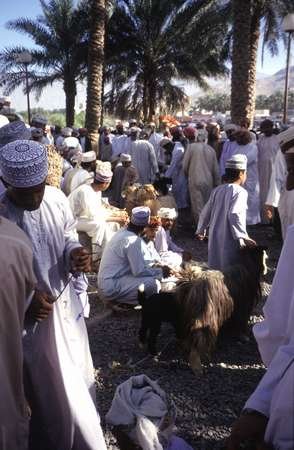
Women in Oman wear very colorful dresses over loose-fitting pants that are gathered tightly at the ankles. They wear scarves on their heads, and a lot of jewelry. In public, most Omani women wear a black ankle-length robe called an abaya, and many veil their faces.
All Omanis wear leather sandals on their feet.
FOOD
EDUCATION
institutes after secondary school. The Sultan Qaboos University was opened for classes in September 1986. Sixty-five percent of its students are female. The literacy rate (ability to read and write) in 1995 was determined to be about 59 percent for Omanis over fifteen years of age. Hundreds of adult-education and literacy centers have been established to help eliminate illiteracy.
The Ministry of National Heritage and Culture was established in 1976. It has restored many historic buildings, including forts, castles, and ancient houses. The Ministry has also built numerous historical museums, libraries, and cultural centers, and organized excavations of ancient remains. Excavations have uncovered pottery jars, beads, and arrowheads dating back to the third millennium BC .
Music is not encouraged by the Ibadi sect of Islam. Yet some folk music has developed in Oman. The Oman Center for Traditional Music was founded in August 1983 to collect and document Omani folk music. Folk music is played on traditional instruments such as drums, a trumpet made out of horn, a straight pipe, and the rebaba, a stringed instrument. Sea chanteys (sailors’ songs) have been sung throughout the sea-faring Omanis’ history. In 1985, Sultan Qaboos established the Royal Oman Symphony Orchestra, as well as a music-training school that is attended by both sexes.
Visual arts in Oman are mostly confined to everyday objects, such as kitchen utensils, rugs, ceramic pots, and clothing.
EMPLOYMENT
In the fertile areas of Oman, most people are farmers. About 10 percent of Omanis are fishers in the Gulf of Oman and Arabian Sea. Boatbuilding is an ancient craft passed down from generation to generation. Traditionally, boats were built from palm fronds, and larger ones from wood. These traditional boats are still used, although recently many fishers have purchased aluminum boats. Sails and oars used to be the means of propulsion; most boats now have motors.
Omani nomads herd sheep, goats, and camels. Oman is the camel-breeding capital of the world.
Although most of Oman’s revenue currently comes from oil, that industry employs only a few thousand Omanis. Roughly two-thirds of laborers in the work force are currently foreign workers.
SPORTS
RECREATION
CRAFTS AND HOBBIES
SOCIAL PROBLEMS
The once nearly extinct white oryx, an antelope, has been successfully reintroduced into the wild in Oman. However, several species of sea turtles continue to be endangered by the Omani taste for turtle soup. Groundwater reserves are being rapidly used up, and the dry climate of today cannot provide enough rain to refill them.
Politically, Oman has operated under a traditional sultanate structure, in which family members are given all the positions of authority and decision-making. This system is quickly becoming harmful to Oman’s welfare. Many commoners are now much better educated and trained in the skills needed for government posts than members of the ruling family. Since the production of oil began in 1970, the ruling family has kept Oman’s citizens quiet by giving them great benefits and financial gifts. In return, citizens have not questioned the way the government is run. But those days are quickly disappearing. Oman has very limited oil reserves and they are likely to run out soon. Government handouts will then have to be severely cut back. Sultan Qaboos is trying to develop non-oil industries, but he has had limited success so far.