 |
| Cygnus X-1 Copyright David A. Hardy
One of the first suspected examples of a black hole was Cygnus X-1. In 1972 a massive blue supergiant star in Cygnus was found to have an invisible companion which emitted X-rays. This was calculated to be 14 times as massive as the Sun – too massive to be a neutron star, so a black hole is the most likely explanation. Here it is seen pulling material away from its companion and becoming strongly heated; hence the X-rays. Excess gas is ejected in two very active jets above and below the disc. (Digital, from Futures.) |
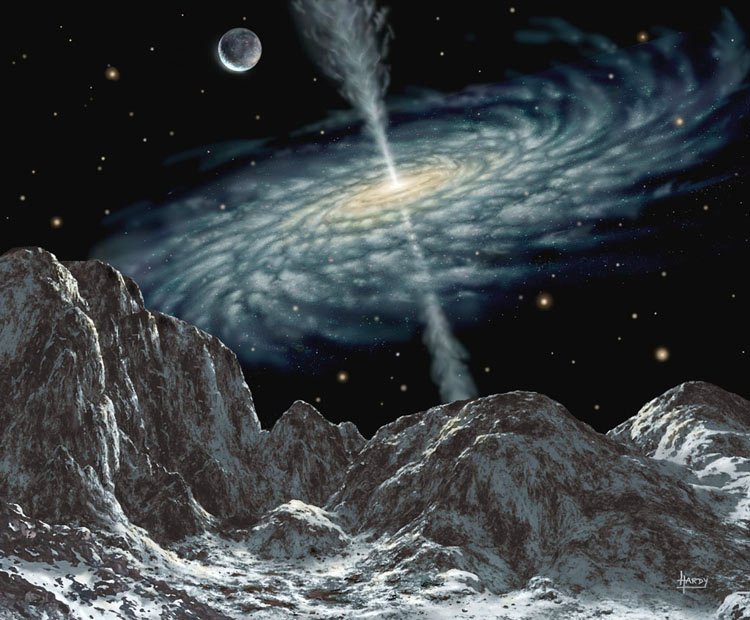 |
| Jetting Galaxy Copyright David A. Hardy
We cannot see the centre of our own galaxy, but it is believed that the nucleus contains a massive black hole, known as Sagittarius A-* (A-star). Indeed most galaxies probably have a black hole at their heart, sweeping up interstellar material into an accretion disc, which persists for some time before the hot gases finally plunge over the ‘event horizon’ into the black hole. Radiation from the hole is guided into narrow jets above and below the ‘doughnut’ of matter, as here. (Digital, from Futures.) |
Copyright DisclaimerCopyright Disclaimer Under Section 107 of the Copyright Act 1976, allowance is made for “fair use” for purposes such as criticism, comment, news reporting, teaching, scholarship, and research. Fair use is a use permitted by copyright statute that might otherwise be infringing. Non-profit, educational or personal use tips the balance in favor of fair use.